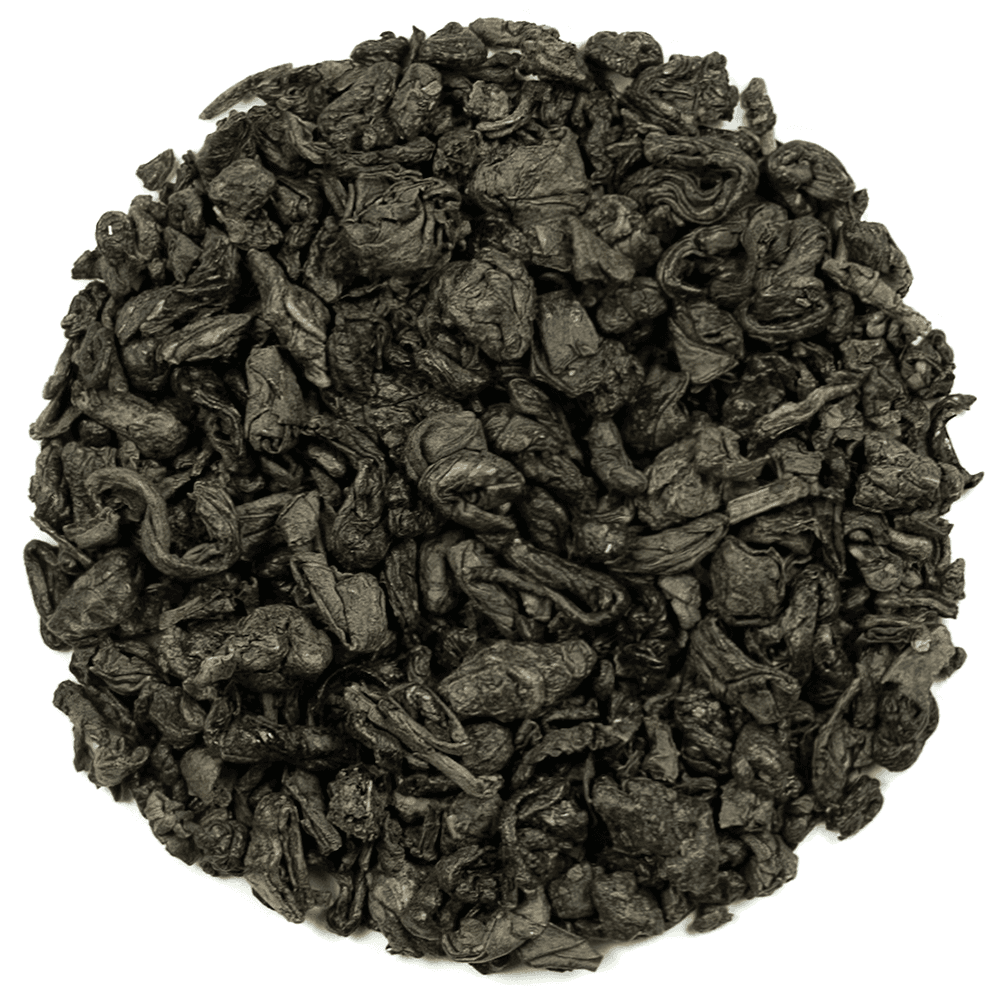
Gunpowder green tea gets its name from the shape, not the flavour: young leaves and buds rolled tight into small round pellets that resemble old musket shot. Nobody has settled on the exact origin of the English name — one story traces it to a port clerk overhearing an Englishman describe the unbrewed leaf as looking like gunpowder, another points to a Mandarin phrase for "freshly brewed tea" that sounds similar when spoken. The Chinese name, zhū chá, means bead tea instead, which is arguably the more sensible label.
The style developed in Zhejiang Province during the Tang Dynasty (618-907 CE), a region whose soil and climate still make it one of the main production areas, and production later spread to Guangdong, Anhui, Hunan and Fujian, each region shaping the taste slightly differently. In the nineteenth century the island of Formosa, now Taiwan, built its own version of the trade: British merchant John Dodd and his partner Li Chunsheng developed Formosa Gunpowder Tea into a well-regarded export.
Making it is a matter of steaming freshly picked leaves, then rolling them by hand or machine into hard pellets before drying. The rolling has to be careful — broken leaves lose the oils that carry the flavour and aroma, and a skilled roller keeps the pellet intact so it can slowly unfurl in the cup. The result is a mix of green and grey pellets that hold their shape until hot water hits them.
In the cup, expect a rich, grassy, smoky character with lemon and mandarin brightness up front, honey underneath, and an earthy, drying finish that stays smooth rather than sharp. It works hot or iced, and a little honey or lemon suits it well. Brew it around 80°C (176°F) for about two and a half minutes, roughly a teaspoon of loose leaf per 8-ounce cup — pull the leaves once it's steeped to your liking, since gunpowder green can turn bitter if left too long.