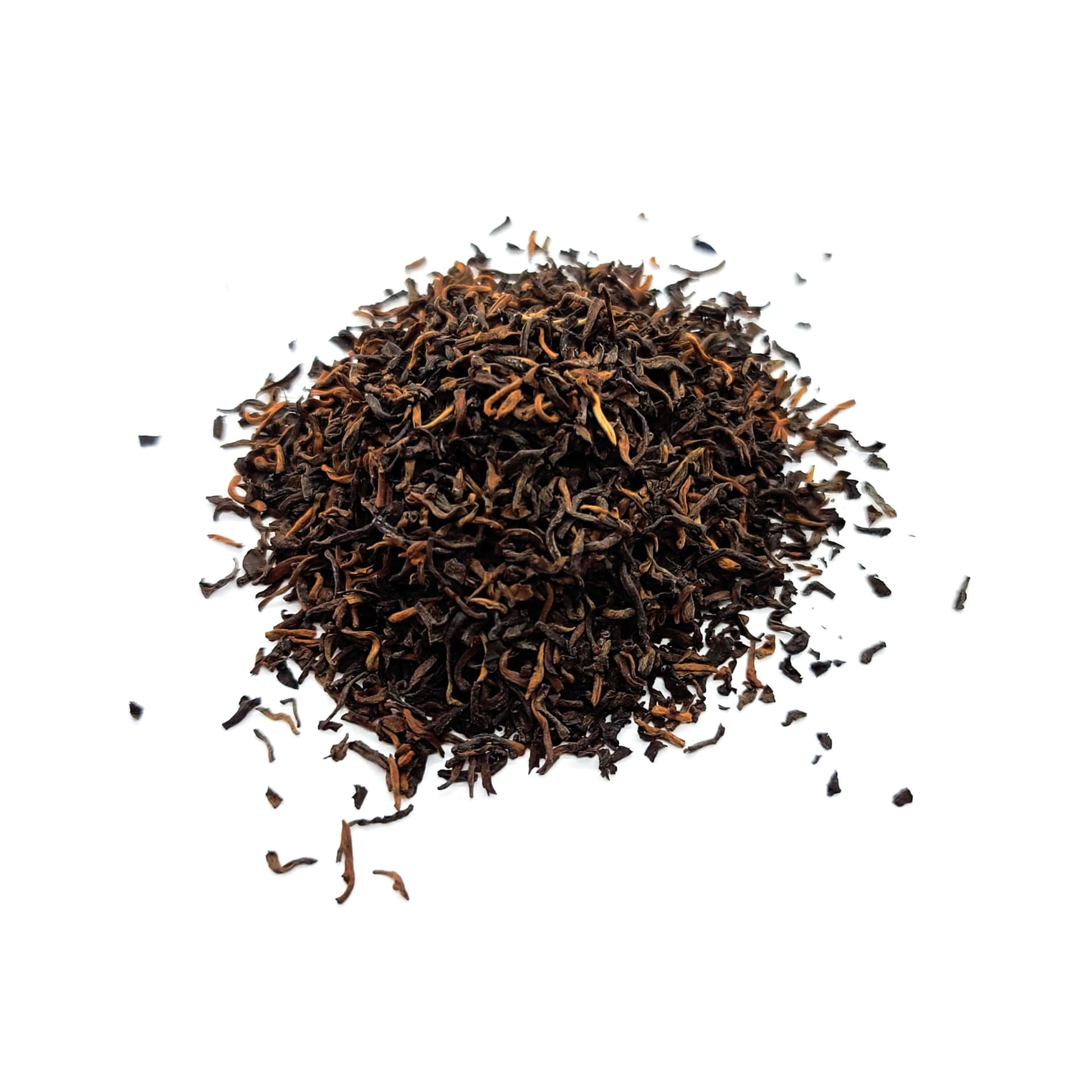
Age is the point here, not a flaw to age past. Pu erh spends time piled and dampened after the usual black tea processing, a stage growers call wòduī, or wet-piling, that pushes the leaves through an extra fermentation most teas never see. The result is a cup with more depth and smoothness than a standard black tea: coppery and dark, with sweet, earthy, woody notes and a faint date-like richness. It grows only in Yunnan province, China, the way Champagne comes only from Champagne or Darjeeling only from Darjeeling, and takes its name from the provincial city of Pu'er, pronounced "poo-air."
There are two Pu erhs. Sheng, the green version, has existed for centuries, possibly since the Han dynasty (206 BCE-220 CE), though other records point to the Ming (1368-1644) or Qing (1644-1912) instead. One theory holds that merchants compressed loose leaf into cakes to carry it more easily, and that the long overland journeys changed the leaves chemically: green turned to amber, then dark teak, while the taste grew livelier and smoother. Shou, the black version made by deliberate wet-piling, is much newer; the process was worked out in 1973 and reached the market as a finished tea in 1975. Compressed into cake form, aged Pu erh can fetch serious money: a 1950s-era 357-gram Red Chop disc has sold for over $10,000. Puyi, the last Emperor of China, is said to have favoured Dragon Well tea in summer and switched to Pu erh once winter came.
Tea & Coffee packs this batch fresh to order at its factory in Pluckley, Kent. Brew it with freshly boiled water and infuse for three to five minutes; most people drink it black, though some add milk.
Pu erh has long been reached for after heavy meals, credited traditionally with settling digestion, and some drinkers turn to it for a hangover the morning after. None of that has been proven the way a clinical result would be; treat it as folk wisdom rather than medicine, and drink it because the cup itself earns it.